
There was a time when the commercial flight simulation scenery market felt relatively straightforward.
Prepar3D had a large and established user base, X-Plane 11 was growing rapidly, and many of the industry’s biggest scenery developers supported more than one simulator. If you were developing an airport, there were several platforms worth considering, and it wasn’t unusual to see the same product appear across multiple simulators.
Then Microsoft Flight Simulator arrived in 2020.
It didn’t simply introduce another platform for scenery developers to support. It changed the size of the audience, the expectations of customers, the economics of development and, ultimately, where much of the commercial scenery market was concentrated.
Six years later, I think we’re still seeing the consequences of that shift.
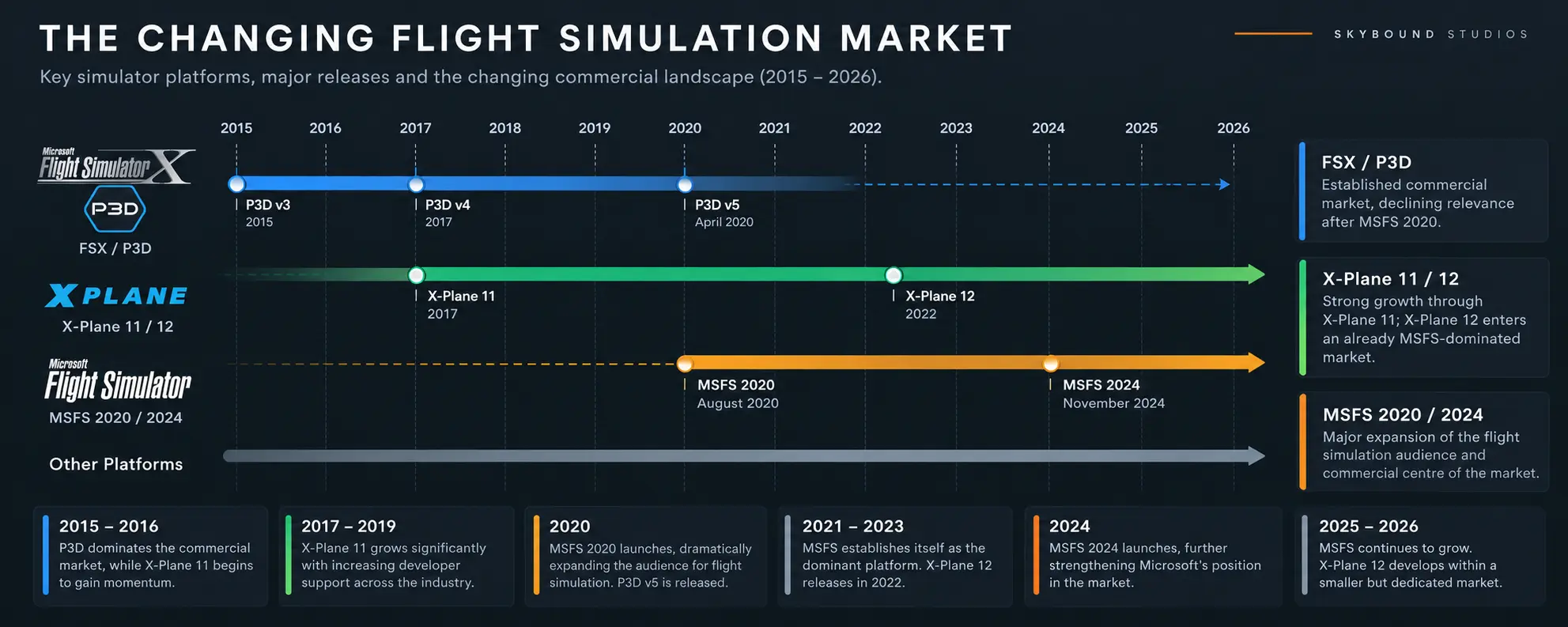 The changing flight simulation market, 2015–2026: major platform releases and the shifting position of the commercial scenery market.
Before MSFS
To understand how much changed, it’s worth looking at where the industry was before 2020.
Prepar3D had become one of the major platforms for serious desktop flight simulation, while X-Plane 11 was gaining users and establishing itself as a credible alternative. There was a large ecosystem of independent scenery developers, publishers and stores supporting both platforms.
For scenery developers, the future didn’t necessarily look like a single-platform market.
X-Plane in particular seemed to have considerable momentum. Users were moving away from the older Microsoft (or Lockheed Martin) simulator ecosystem, while X-Plane 11 offered a modern alternative with a strong community and an increasingly large catalogue of third-party content.
Companies such as Orbx were supporting multiple platforms, while independent developers could build products specifically for X-Plane or Prepar3D and potentially expand them elsewhere.
The market was fragmented, but there was room for multiple platforms to have a meaningful commercial presence.
Then MSFS arrived.
MSFS Wasn’t Just Another Simulator
The most obvious change was visual.
Microsoft Flight Simulator represented a huge leap in what users expected the world outside the airport to look like. But I think the more important change was what that visual experience did to the size and accessibility of the market.
MSFS made the idea of flying almost anywhere in the world immediately understandable. You could open the simulator, pick a location and see a recognisable version of that location underneath you. Aerial imagery, terrain, buildings, roads, vegetation and water all worked together to create something that felt much more like a representation of the real world than the traditional simulator environment.
That mattered to scenery developers.
A scenery developer ultimately needs customers, and MSFS brought a much larger potential audience into flight simulation. It also broadened the type of person who could be interested in the hobby. You didn’t necessarily need years of experience with flight simulation to understand what made MSFS impressive.
The proposition was simple: you could choose somewhere in the world and go flying.
That was a powerful proposition for customers, but it was equally significant for the companies producing content for the simulator. The arrival of MSFS wasn’t simply another competitor entering the market. It significantly increased the amount of commercial attention being directed towards flight simulation.
The Centre of Gravity Moved
Once MSFS established itself, developers naturally followed the audience.
This isn’t particularly complicated from a business perspective. An airport can represent months of development work. There might be modelling, texturing, ground work, vegetation, lighting, optimisation, testing, marketing, customer support and updates involved before a product ever reaches a store.
At the end of all that, the developer needs enough customers to make the investment worthwhile.
The larger the potential audience, the more opportunities there are to recover that investment. A larger audience also makes it easier for developers to justify investing more time and money into their products, which in turn gives customers access to increasingly sophisticated scenery.
That creates a feedback loop. More customers make a platform more attractive to developers, more developers create more products, and more products make the platform more attractive to customers.
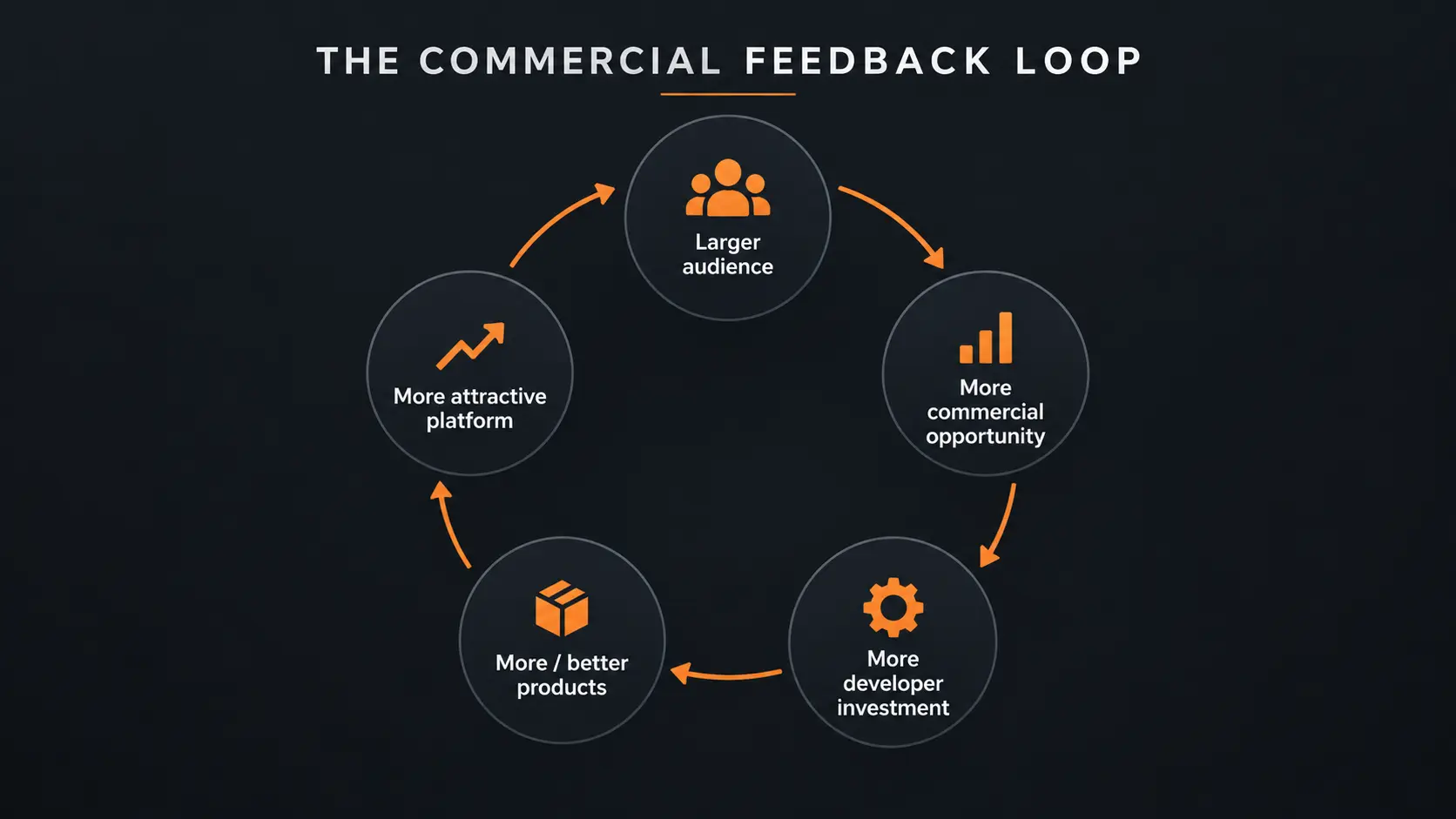 The commercial feedback loop: a larger audience creates greater commercial opportunity, encouraging further developer investment and product availability.
This doesn’t mean that every developer abandoned other simulators. Many didn’t. But the commercial centre of gravity had clearly moved.
Prepar3D Shows How Quickly a Market Can Change
Prepar3D is probably the clearest example.
Before MSFS, it was a major part of the commercial flight simulation scenery market. There were established developers, large product catalogues and a sizeable customer base.
MSFS fundamentally changed the trajectory of that market.
The important thing isn’t necessarily that Prepar3D suddenly became unusable. It was that developers and customers were suddenly presented with a new platform that offered a dramatically different experience and, crucially, a much larger consumer opportunity.
For developers, continuing to invest heavily in an older platform became harder to justify. For customers, the prospect of moving to a new simulator became increasingly attractive. The commercial ecosystem moved with them.
This is one of the things that can be easy to overlook when looking at the scenery market today. The market didn’t simply grow. A significant part of it moved.
X-Plane Was Left in a Very Different Position
This is where the story gets more complicated.
X-Plane didn’t disappear. It retained a very dedicated community, an enormous freeware ecosystem and a strong group of developers and users who continue to prefer it for a variety of reasons.
But X-Plane 12 entered the market at a very different point in the industry’s history.
If a new version of X-Plane had arrived before MSFS, it would have entered an environment where there was a much larger pool of users looking for an alternative to the traditional Microsoft simulator ecosystem. Instead, by the time X-Plane 12 arrived, MSFS had already established itself.
The people who might previously have moved from Prepar3D towards X-Plane had another option, and for many of them, that option was MSFS.
That matters because X-Plane 12 inherited a strong existing X-Plane community, but it did not necessarily inherit the much larger wave of potential customers that might have existed in a pre-MSFS market.
The difference can be seen in the current distribution of simulator usage:
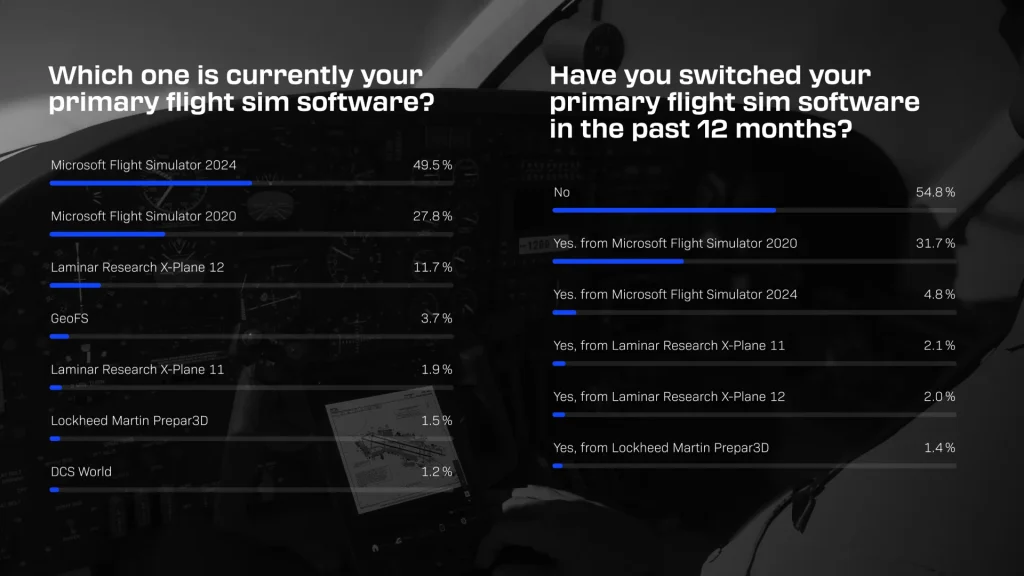 Source: Navigraph, 2026 FlightSim Community Survey.
Those figures shouldn’t be interpreted as a precise measurement of every flight simmer in the world. They do, however, illustrate the scale difference between the major platforms within the surveyed community.
For a scenery developer, that difference matters. A product with the same development cost can have a very different commercial outcome depending on the size of the audience it is being sold to.
A Large Community Doesn’t Necessarily Mean a Large Payware Market
This is one of the things I find most interesting about X-Plane.
It is possible for a simulator to have a very active and passionate community while still being a difficult commercial market for payware developers. Those things aren’t contradictory.
X-Plane has always had a huge amount of freeware available. Its openness and customisation are part of what makes the platform attractive in the first place. A user can spend hundreds of hours improving their simulator without necessarily spending hundreds of pounds on commercial scenery.
There is also a difference between engagement and purchasing behaviour. Someone might fly X-Plane every week, download freeware, install aircraft and spend hours modifying their setup, while rarely buying scenery.
For a developer, the important number isn’t simply how many people use the simulator. It is how many of those people are likely to buy a particular product.
That is a much harder number to determine, and I think it is part of the reason the X-Plane payware market can sometimes feel smaller than the enthusiasm surrounding the simulator would suggest.
The Problem for Developers Has Changed
Before MSFS, the question for a scenery developer might have been which simulator to build an airport for.
Today, the question is increasingly how to make that airport commercially viable across the platforms that matter.
That’s a very different problem.
Building a high-quality airport from scratch is expensive regardless of the simulator. But there is another possibility: what if the airport already exists?
A developer might already have detailed models, textures, reference material and years of development work invested in a product for one simulator. Recreating everything from scratch for another platform could make the project commercially impossible.
Adapting it can be a very different proposition.
The work involved is still substantial. Different simulators have different scenery systems, materials, lighting, terrain, vegetation and performance requirements, and a conversion can sometimes require significant redevelopment. But the starting point is fundamentally different when the underlying assets already exist.
That can completely change the economics of a project.
Existing Scenery Has Another Life
This is one of the areas I think could become increasingly important over the coming years.
The flight simulation industry has accumulated an enormous amount of development work. There are airports that have existed for years, developers with extensive libraries of high-quality assets, and products that may no longer receive active development because the original platform or market has changed.
That doesn’t necessarily mean those products have reached the end of their commercial life.
Sometimes the opportunity isn’t to create something new. It is to take something that already exists and find another audience for it.
This is particularly interesting when looking at MSFS and X-Plane. A product with a strong history on one platform may have an opportunity to reach an entirely different audience through a carefully managed conversion.
It also creates opportunities for collaboration.
One developer might have the original models and textures. Another might specialise in a particular simulator. Someone else might be better placed to handle publishing, quality assurance, marketing or customer support.
The industry already works this way to an extent, but I think there is room for considerably more collaboration as development costs and platform differences continue to grow.
The Scenery Developer Is Becoming More Than a Scenery Developer
This is perhaps the biggest change from my perspective.
The job used to be relatively easy to describe: make an airport and sell it.
Today, there are considerably more decisions involved:
- Which platform should it be built for?
- Which audience is most likely to buy it?
- What assets already exist?
- Can they be adapted?
- What will development cost?
- Where should it be sold?
- How should it be marketed?
- Does the existing product have a customer base?
- Is a conversion commercially viable?
- Should the project be funded upfront or through revenue share?
These questions can be just as important as the actual scenery development.
That means the role of the scenery developer is changing. The companies that succeed may not necessarily be the ones that can produce the most polygons. They may be the ones that can identify which projects are worth producing in the first place, and find the most effective way of getting those projects in front of customers.
So What Happens Next?
I don’t think the lesson from MSFS is that X-Plane is finished.
Far from it.
I think the lesson is that the flight simulation scenery market has become much more commercially uneven.
MSFS has a huge audience and has become the obvious first consideration for many developers. X-Plane has a smaller but highly dedicated audience and remains an important part of the industry. Other platforms continue to exist, but their commercial positions have changed dramatically.
The result is an industry where simply choosing a simulator and building a product isn’t necessarily enough anymore.
Developers have to think about how the product is funded, where it can be sold, who is likely to buy it and whether existing work can be reused across platforms.
I think that’s where some of the most interesting opportunities are going to come from. Not necessarily bigger development teams or more expensive airports, but better decisions about what gets developed, who develops it and where the finished product can be sold.
The scenery market has changed enormously since 2020.
MSFS didn’t just give us a new simulator. It changed the economics of the entire industry around it.
And six years later, I don’t think we’ve finished seeing the consequences.
About Skybound Studios
At Skybound Studios, we work with developers and studios to develop, adapt and publish scenery for X-Plane and Microsoft Flight Simulator. From bringing existing products to new platforms to developing new projects, our focus is on creating scenery that is worth making and worth flying.